
The Battle for the Aravallis: Why We Must Protect Every Tree and Hill
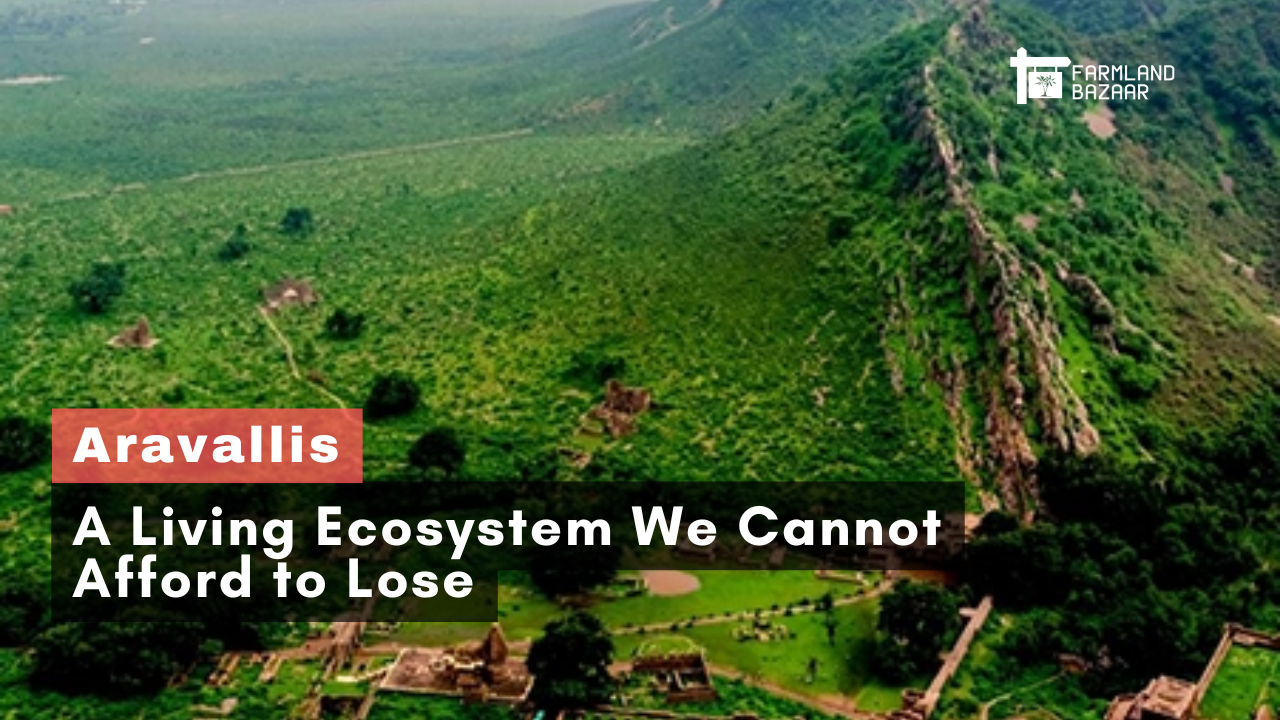
In the parts of Delhi and Gujarat stretched across Rajasthan and Haryana lies the Aravalli range, one of the oldest mountain systems in the world. Older than imaginations, older than the Himalayas, these hills have quietly and constantly supported life on the Indian subcontinent for millions of years. And have done their part quite well in maintaining the air quality, combating dust storms and preserving water. Still today, they are among the most threatened natural ecosystems in the country.
This land is not just an asset to India but is a living system that supports water, food, climate balance and communities that include you, me and all of us. The battle for the Aravallis is not just about saving a forest range. It is about protecting the foundation of ecological and economic stability for present and future generations, it's about preserving life on Earth.
The Recent News: A "Death Warrant" for the Aravallis?
In November and December 2025, a storm has gathered over the Aravalli hills following a controversial legal redefinition. The Supreme Court of India accepted a proposal that defines an “Aravalli hill” only by elevation, meaning landforms with a height difference of 100 metres or more.
While this was meant to bring clarity to regulations, the real impact on the ground could be devastating:
-
90% Protection Loss: In states like Rajasthan and Haryana, most of the Aravalli landscape is made up of low ridges, scrub forests, hillocks and shallow slopes. These natural formations fall below the 100-metre limit. As a result, nearly 90 percent of the Aravalli range risks losing its protected status.
-
The 8.7% Status: According to data from the Forest Survey of India, only about 8.7 percent of what was earlier considered part of the Aravallis would remain legally recognised under this new definition.
-
The Green Barrier at Risk: By de-classifying 90% of the range, the door opens to large-scale mining, unchecked real estate activity and forest loss. More importantly, it weakens the natural barrier that slows the spread of the Thar Desert toward Delhi NCR and the Indo-Gangetic plains.
What appears to be a technical definition could, in reality, reshape the ecological future of North India.
Why the Aravallis Matter More Than We Think
The Aravallis act as a natural barrier against desertification. They slow the eastward expansion of the Thar Desert, regulate regional climate and play a critical role in groundwater recharge across North India. Many rivers and seasonal streams originate or many are sustained by this range which directly supports agriculture and drinking water supplies in states like Rajasthan, Haryana and Delhi NCR.
These hills are also biodiversity hotspots. Leopards, hyenas, jackals, birds, reptiles and countless plant species depend on this fragile ecosystem. Each tree and hill contributes to soil stability, rainfall patterns and carbon absorption.
When we lose the Aravallis, we do not just lose green cover. We lose water security, climate resilience and food systems.
Why This Matters to Future Generations
The destruction of the Aravallis is not a distant environmental issue. It directly affects children growing up today.
When green cover disappears, cities become hotter, air quality worsens, water becomes scarce, and food systems grow fragile. We are already struggling with polluted air, adulterated food, and extreme temperatures. These are no longer future risks. They are part of everyday life.
Now pause and think about what this means for our children. What kind of world are we leaving them? A life filled with technology, but stripped of clean air, safe food, and access to nature. A future where survival becomes harder, even as progress appears faster.
Is this the legacy we want to leave behind? Farmlandbazaar understands once forest ecosystems collapse, rebuilding them is costly and slow, if not impossible. But protecting every tree and hill today is an investment in the health, safety and stability of future generations.
So why does this matter so deeply to us?
Because FarmlandBazaar represents the voice of farms, trees, and nature itself. Our mission has always been to bring people closer to the land, not to give them a front-row seat to its destruction.
We are fundamentally against the cutting of trees. We stand for forests, jungles, and the biodiversity they hold. We believe a forest is a forest, no matter how small. A cluster of trees is not expendable simply because it is convenient to ignore.
We also take a firm stand against the silent cutting of trees. Often, small numbers of trees are removed in phases to avoid attention or regulation. This practice may appear harmless, but its impact is anything but.
To understand why we care even about a small cluster of trees, especially in fragile ecosystems like the Aravallis, we must first understand a simple but powerful truth about how trees work together.
-
The Micro-Climate Effect: Even 50 trees on a single plot can lower the local temperature by 2-3°C and act as a massive carbon sink.
-
Groundwater Recharge: The Aravallis are a "water tower." Their fractured rocks and root systems allow up to 2 million liters of water per hectare to seep into the ground. Cutting trees stops this recharge, deepening the water crisis in cities like Gurugram and Faridabad.
The Government side:
The government has introduced an important initiative called the Aravalli Green Wall Project, which aims to plant billions of trees to slow desertification and protect fragile regions. At FarmlandBazaar, we fully support this vision.
However, planting trees is only part of the solution. Plants take nearly 15 to 20 years to grow into a mature tree. The question we must ask ourselves is simple but urgent. Are we willing to risk the loss of millions of existing trees, and the lives and ecosystems they support, while we wait two decades for new plantations to take their place?
Planting new trees is essential, especially given the air quality and climate challenges we already face. But it cannot come at the cost of cutting down the forests that are already standing. Protection must come before replacement.
At FarmlandBazaar, we encourage our community to choose land and development practices that respect nature. Growth should not come at the cost of nature. We believe in agroforestry because it allows people to grow food and create value without clearing what already exists. Trees, soil, water and livelihoods can thrive together when the land is treated with care.
We are clear about our stand and we will never support the destruction of the Aravallis’ natural beauty. Because preserving what exists today is the strongest foundation for a sustainable tomorrow. The Aravallis are not just rocks and dirt; they are the lungs of North India. If we allow them to be chipped away hill by hill, tree by tree; we are stealing the future from our children.
Whether a hill is 100 meters high or just 10, and whether a forest has 1,000 trees or just 50, it deserves to stay. The battle for the Aravallis is a test of priorities. Do we see land only as a commodity to be consumed, or as a shared resource to be protected?
Written by Farmland Bazaar Team
Agricultural assets advisor contributing to Farmland Bazaar v2. Focusing on organic investments, soil analysis reports, and deed checks.